


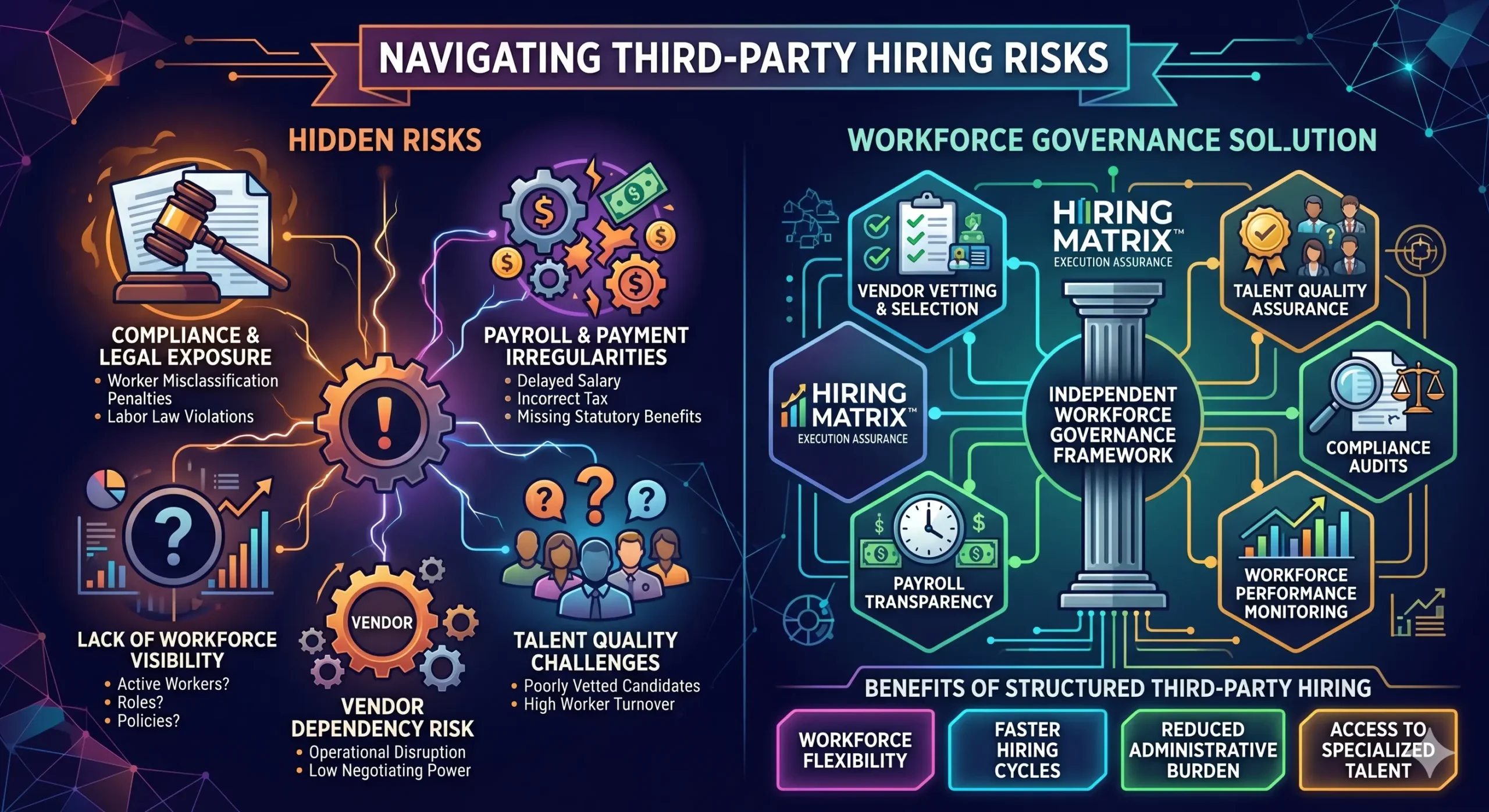
Modern enterprises are increasingly relying on third-party hiring models to build flexible, scalable workforces. Instead of hiring every employee directly, organizations now engage staffing partners, contract hiring vendors, and payroll providers to manage large segments of their workforce.
This approach offers significant benefits such as:
- Faster workforce scaling
- Reduced recruitment overhead
- Access to specialized talent
- Operational flexibility
However, third-party hiring also introduces serious risks that many companies underestimate.
When these risks are not managed properly, organizations can face:
- Legal and compliance issues
- Payroll irregularities
- Worker misclassification penalties
- Vendor dependency problems
- Declining workforce productivity
This is why many enterprises now introduce structured workforce governance frameworks to manage third-party hiring relationships effectively.
Execution assurance partners like Hiring Matrix™ help organizations reduce these risks while maintaining the benefits of workforce flexibility.
Understanding the Third-Party Hiring Model
Third-party hiring occurs when a company sources talent through an external organization rather than hiring workers directly onto its payroll.
Common third-party workforce models include:
Contract Staffing –Employees work on the client’s projects but remain on the payroll of a staffing company.
Third-Party Payroll Management – Workers are recruited by the client but placed on the payroll of an external payroll provider.
Managed Workforce Programs – Entire workforce segments are managed by external vendors responsible for hiring, payroll, compliance, and operations.
These models allow enterprises to scale quickly, but they also introduce additional layers of complexity.
The Hidden Risks of Third-Party Hiring
1. Compliance and Legal Exposure – Labor laws vary significantly across regions and industries. When organizations rely on external vendors for hiring and payroll management, they often assume that compliance responsibility lies entirely with the vendor.
In reality, the end client frequently remains legally accountable for many workforce-related violations.
Potential risks include:
- Incorrect employment classification
- Violations of labor laws
- Incomplete employee documentation
- Regulatory non-compliance
These issues can result in heavy financial penalties and reputational damage.
2. Payroll and Payment Irregularities – Payroll management becomes more complex when multiple vendors handle employee compensation.
Common problems include:
- delayed salary payments
- incorrect tax deductions
- missing statutory benefits
- inaccurate payslip reporting
Even if payroll is handled by a third party, employees typically associate these problems with the client organization.
This can damage employer reputation and reduce workforce morale.
3. Lack of Workforce Visibility – When large portions of a workforce are managed by external vendors, companies often lose visibility into key workforce metrics.
Questions become difficult to answer, such as:
- How many third-party workers are active?
- What are their roles and responsibilities?
- Are performance standards being maintained?
- Are vendors complying with workforce policies?
Without visibility, workforce management becomes reactive rather than strategic.
4. Vendor Dependency Risk – Organizations sometimes become overly dependent on a single staffing or payroll vendor.
This creates several risks:
- operational disruption if the vendor fails
- limited negotiating power
- lack of competitive vendor alternatives
Vendor dependency can also lead to declining service quality over time.
5. Talent Quality Challenges – Third-party hiring vendors often prioritize speed over quality.
This can result in:
- poorly vetted candidates
- inconsistent talent standards
- high worker turnover
For enterprise projects, these issues can significantly impact productivity and delivery outcomes.

Why Enterprises Need Workforce Governance
To address these risks, companies are increasingly implementing workforce governance frameworks.
Workforce governance involves structured oversight mechanisms that ensure third-party hiring programs remain:
- compliant
- transparent
- performance-driven
- scalable
Rather than relying entirely on staffing vendors, organizations introduce independent oversight and accountability structures.
The Role of Execution Assurance Partners
Execution assurance partners act as independent intermediaries between enterprises and workforce vendors.
Their role is to ensure that:
- hiring vendors meet quality standards
- payroll and compliance processes remain accurate
- workforce performance is monitored
- vendor accountability is maintained
This governance model significantly reduces operational risk.
How Hiring Matrix™ Manages Third-Party Workforce Risks
Hiring Matrix™ provides a structured approach to third-party workforce management.
Vendor Vetting and Selection – Before engaging staffing partners, Hiring Matrix™ evaluates vendors based on:
- compliance track record
- payroll reliability
- talent sourcing capability
- operational stability
This ensures enterprises only work with reliable partners.
Workforce Governance – Hiring Matrix™ introduces structured oversight through:
- workforce performance monitoring
- vendor accountability frameworks
- compliance audits
- payroll transparency
This governance model ensures workforce programs remain stable and predictable.
Talent Quality Assurance – Every hiring partner within the Hiring Matrix™ ecosystem must maintain strict quality benchmarks.
This reduces the risk of inconsistent talent deployment.
Vendor Diversification Strategy – Rather than relying on a single vendor, Hiring Matrix™ helps enterprises build diversified vendor ecosystems.
This improves resilience and negotiation leverage.
Benefits of Structured Third-Party Hiring
When managed properly, third-party hiring can provide powerful advantages.
Workforce Flexibility – Companies can quickly expand or reduce workforce capacity.
Faster Hiring Cycles – External partners accelerate talent acquisition.
Reduced Administrative Burden – Payroll, compliance, and HR administration can be managed externally.
Access to Specialized Talent – Enterprises can quickly access niche skills required for specific projects.
The Future of Workforce Management
As global workforce models evolve, third-party hiring will continue to grow.
However, organizations that succeed will be those that balance flexibility with structured governance.
Instead of treating workforce vendors as independent entities, enterprises will increasingly rely on execution assurance partners to ensure stability and accountability.
Conclusion
Third-party hiring offers powerful benefits for modern enterprises, but it also introduces hidden risks that can impact compliance, workforce quality, and operational stability.
Organizations that implement structured workforce governance frameworks are far more likely to achieve sustainable workforce scalability.
By acting as an independent oversight layer, Hiring Matrix™ helps enterprises unlock the benefits of third-party hiring while minimizing the associated risks.