


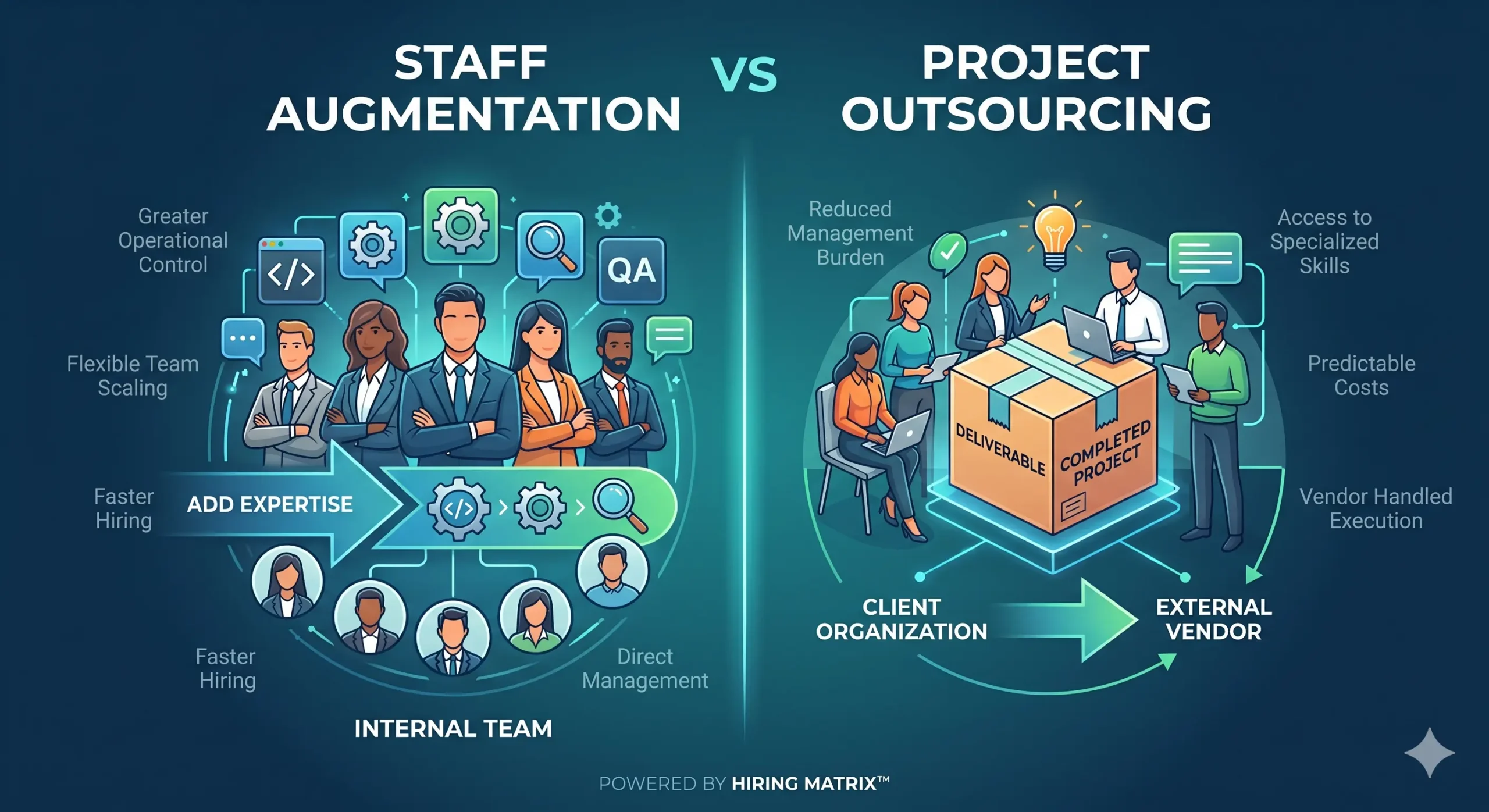
Enterprises constantly face a critical decision when building technology teams:
Should the organization extend internal teams through staff augmentation, or should it outsource entire projects to external vendors?
Both models are widely used across industries, yet many organizations struggle to determine which approach best suits their needs.
The answer often depends on factors such as:
- Project Complexity
- Internal Expertise
- Delivery Timelines
- Governance Capabilities
Understanding the differences between these models helps enterprises make smarter workforce decisions.
What Is Staff Augmentation?
Staff augmentation involves adding external professionals to an organization’s existing teams.
These professionals typically work under the direction of the client’s internal managers.
Examples include:
- Contract Software Engineers
- Temporary Product Managers
- Data Analysts
- QA Specialists
The augmented staff operates as an extension of the internal workforce.
Benefits of Staff Augmentation
Greater Operational Control – Enterprises maintain full control over project direction and priorities.
Seamless Team Integration – External professionals work directly with internal teams.
Flexibility – Companies can scale teams up or down quickly depending on project needs.
Faster Hiring – Staff augmentation providers maintain talent pools that can fill roles quickly.
What Is Project Outsourcing?
Project outsourcing involves assigning entire projects or deliverables to external vendors.
The vendor is responsible for managing:
- Team Composition
- Project Execution
- Delivery Timelines
The client organization focuses primarily on defining project requirements and reviewing deliverables.

Benefits of Project Outsourcing
Reduced Management Burden – The vendor handles team management and operational responsibilities.
Access to Specialized Expertise – Many outsourcing firms specialize in specific technologies.
Predictable Project Costs – Many outsourcing contracts operate on fixed-price or milestone-based payment models.
Challenges of Staff Augmentation
Despite its advantages, staff augmentation has limitations.
- Requires strong internal project management
- Internal teams must coordinate external talent effectively
- Scaling large teams quickly can be challenging
Without proper governance, augmented teams can become inefficient.
Challenges of Project Outsourcing
Project outsourcing also introduces risks.
- Reduced Visibility into Vendor Operations
- Potential Quality Inconsistencies
- Communication Challenges
- Vendor Dependency Risks
If the vendor underperforms, project timelines can be severely impacted.
Choosing the Right Model
Enterprises should evaluate several factors before choosing between staff augmentation and outsourcing.
Internal Leadership Capacity
Organizations with strong internal leadership often prefer staff augmentation.
Project Complexity
Highly complex projects may benefit from specialized outsourcing vendors.
Delivery Speed
Staff augmentation often provides faster integration with existing teams.
Budget Flexibility
Outsourcing may provide more predictable cost structures.
The Hybrid Delivery Model
Many successful enterprises combine both models.
For example:
- Core teams remain internal
- External specialists are added through staff augmentation
- Certain modules are outsourced to specialized vendors
This hybrid approach balances flexibility with efficiency.
How Hiring Matrix™ Supports Both Models
Hiring Matrix™ helps enterprises evaluate project requirements and identify the best workforce model.
The firm supports organizations through:
- talent sourcing for staff augmentation
- vendor selection for project outsourcing
- delivery governance and execution oversight
This ensures both models operate effectively.
Conclusion
There is no universal answer to the staff augmentation vs outsourcing debate.
The most successful organizations adopt flexible workforce strategies that combine both models when necessary.
With structured governance and reliable vendor ecosystems, enterprises can achieve faster delivery, improved quality, and greater operational efficiency.