


Large organizations invest millions of dollars every year into digital transformation, software development, and IT modernization. Despite these investments, a shocking number of projects fail to deliver expected outcomes.
According to industry studies, nearly 70% of enterprise digital transformation initiatives fail to meet their objectives. These failures rarely occur because of poor ideas or lack of funding. Instead, they happen because of execution failure.
This is where execution governance becomes critical.
Organizations increasingly rely on specialized partners like Hiring Matrix™ to ensure enterprise projects are delivered successfully by maintaining alignment between stakeholders, vendors, and execution teams.
The Real Reason Enterprise Projects Fail
Many enterprises assume project failure happens due to technical challenges. In reality, most failures are caused by execution breakdowns.
1. Vendor Misalignment
Large organizations frequently outsource development work to offshore vendors or technology partners.
However, problems arise when:
- Delivery timelines are unrealistic
- Quality standards are inconsistent
- Communication between stakeholders is weak
- Vendors prioritize other clients
Without oversight, projects quickly drift off track.
2. Lack of Execution Accountability
Many enterprises operate under the assumption that the vendor will manage everything.
Unfortunately, most vendors focus primarily on delivery tasks, not overall project accountability.
This creates a gap between:
- Strategy
- Execution
- Business outcomes
When no one owns the execution governance layer, delays and failures become inevitable.
3. Talent Quality Issues
Another major challenge is talent inconsistency.
Even reputable vendors sometimes deploy:
- Junior engineers
- Underqualified specialists
- Rotating delivery teams
This disrupts continuity and reduces delivery quality.
4. Poor Stakeholder Coordination
Enterprise projects often involve multiple teams:
- Product teams
- IT leadership
- External vendors
- Internal business stakeholders
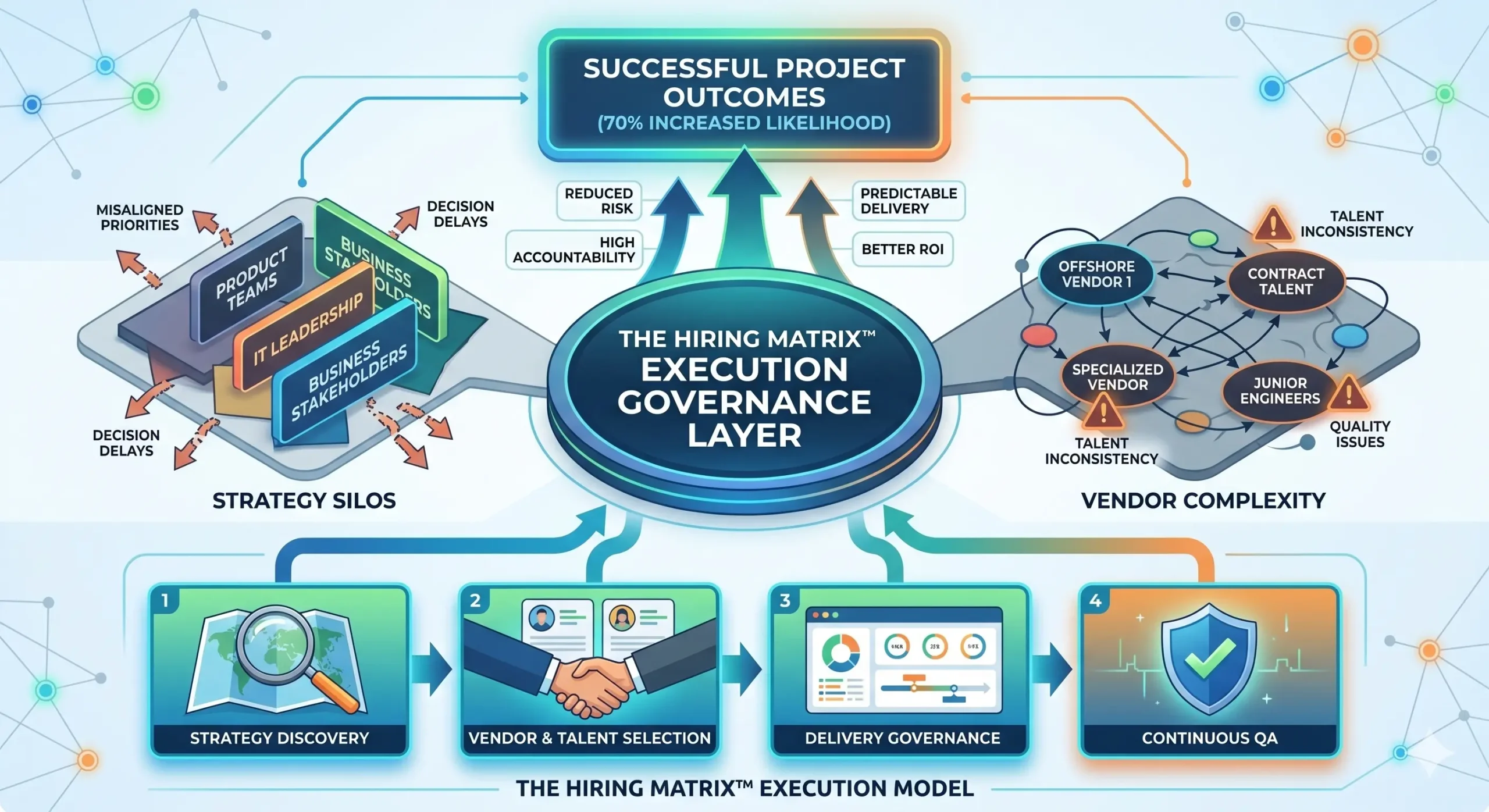
Without centralized coordination, these groups frequently operate in silos.
This leads to:
- Scope confusion
- Misaligned priorities
- Decision delays

What Is Execution Governance?
Execution governance is a structured framework that ensures enterprise initiatives are delivered successfully through:
- Strategic oversight
- Vendor accountability
- Performance monitoring
- Delivery quality control
Instead of leaving delivery entirely to vendors, companies introduce an independent governance layer.
This layer ensures:
- Vendors remain accountable
- Delivery stays aligned with business goals
- Execution risks are identified early
The Role of an Execution Assurance Partner
An execution assurance partner acts as a strategic intermediary between enterprise clients and delivery vendors.
This model ensures that projects maintain consistent quality and predictable outcomes.
At Hiring Matrix™, the focus is not simply on connecting companies with vendors. The focus is on owning execution accountability across the entire lifecycle.
This includes:
- Vendor selection
- Talent quality validation
- Delivery monitoring
- Performance governance
The Hiring Matrix™ Execution Model
The Hiring Matrix™ framework helps enterprises eliminate delivery uncertainty.
Phase 1: Strategy Discovery
Before recommending vendors or teams, the organization first evaluates:
- Project objectives
- Technical requirements
- Execution risks
- Talent needs
This ensures the right delivery strategy is chosen.
Phase 2: Vendor & Talent Selection
Hiring Matrix™ identifies the most suitable partners from a vetted network of:
- offshore development companies
- specialized technology vendors
- contract talent providers
Each partner undergoes strict evaluation to ensure reliability.
Phase 3: Delivery Governance
Once execution begins, Hiring Matrix™ monitors delivery performance through:
- milestone tracking
- quality reviews
- performance reporting
- vendor accountability mechanisms
This governance layer significantly reduces execution risk.
Phase 4: Continuous Quality Assurance
Quality assurance remains active throughout the project lifecycle.
This ensures:
- deliverables meet enterprise standards
- timelines remain realistic
- project risks are mitigated early
Why Enterprises Are Moving Toward Governance Models
More enterprises are adopting governance-driven delivery models because traditional outsourcing approaches often fail.
Key benefits include:
Reduced Execution Risk
Projects are continuously monitored, preventing major failures.
Higher Vendor Accountability
Vendors remain accountable to performance benchmarks.
Improved Delivery Predictability
Milestones are tracked carefully, reducing surprises.
Better ROI From Technology Investments
Projects deliver measurable business outcomes.
Real-World Example
Consider a large enterprise building a customer platform.
Without governance:
- vendor delays occur
- development quality declines
- project budgets expand
With execution governance:
- performance is monitored
- delivery risks are flagged early
- vendors remain accountable
The difference often determines whether a project succeeds or fails.
The Future of Enterprise Project Delivery
As digital transformation accelerates, enterprises are increasingly managing complex vendor ecosystems.
This complexity requires structured oversight.
Execution governance will likely become a standard practice across large organizations, particularly for projects involving:
- offshore development
- multiple vendors
- large-scale digital platforms
Companies that implement governance frameworks will experience significantly higher project success rates.
Conclusion
Enterprise project failure rarely results from poor ideas or insufficient funding.
Instead, failure occurs because execution risks go unmanaged.
Execution governance introduces the structure, accountability, and oversight required to ensure complex initiatives succeed.
By acting as a strategic intermediary between enterprise clients and delivery partners, Hiring Matrix™ helps organizations transform ambitious plans into predictable outcomes.